

Freedom Always — Japan Series, Part Four
Arriving in Kyoto reminded us that our trip was coming to a close, and we weren’t ready to say goodbye to Japan. This isn’t just a Kyoto travel guide to the places we visited — it’s the story of a city that asked us to slow down enough to notice everything it wanted to show us. If Kanazawa taught us patience through gold leaf, Kyoto would teach us something quieter: how to sit with a place long enough to let it change you.”
Fushimi Inari Taisha: Where Every Kyoto Travel Guide Begins
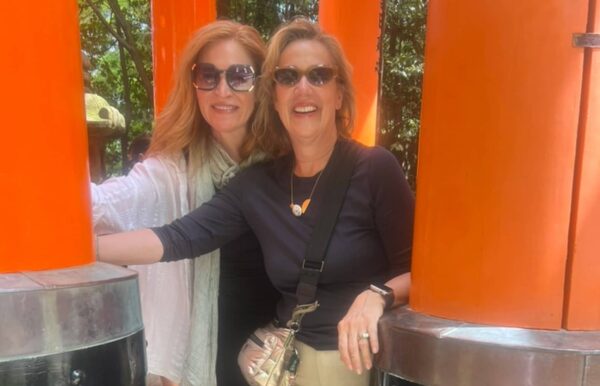
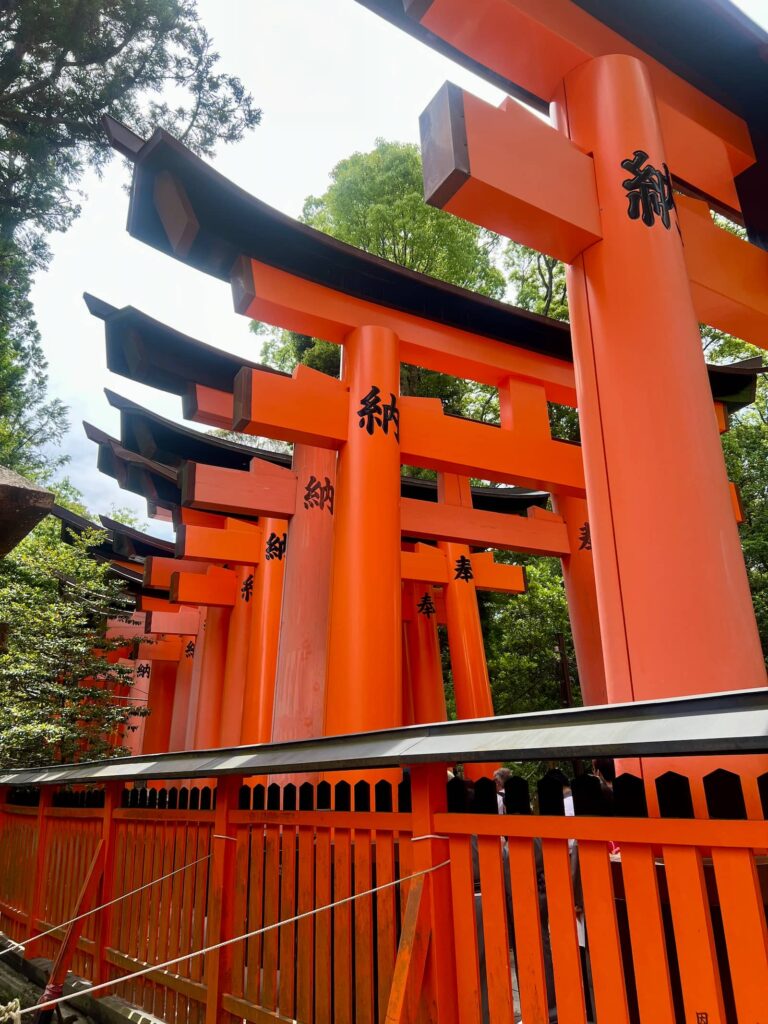
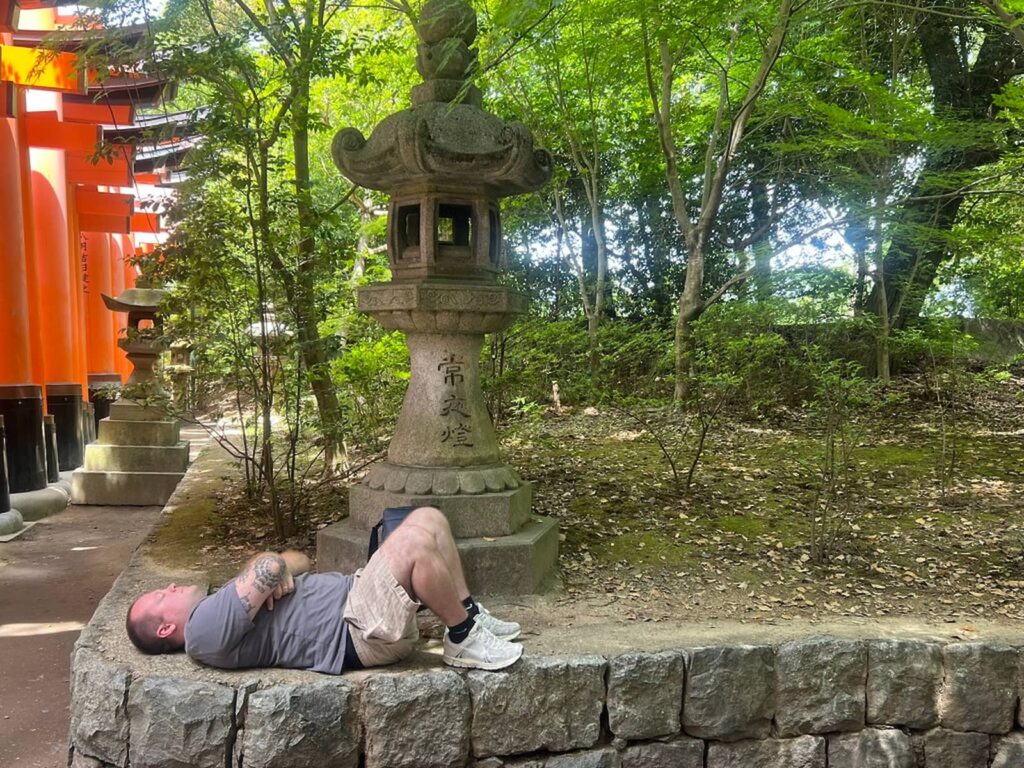
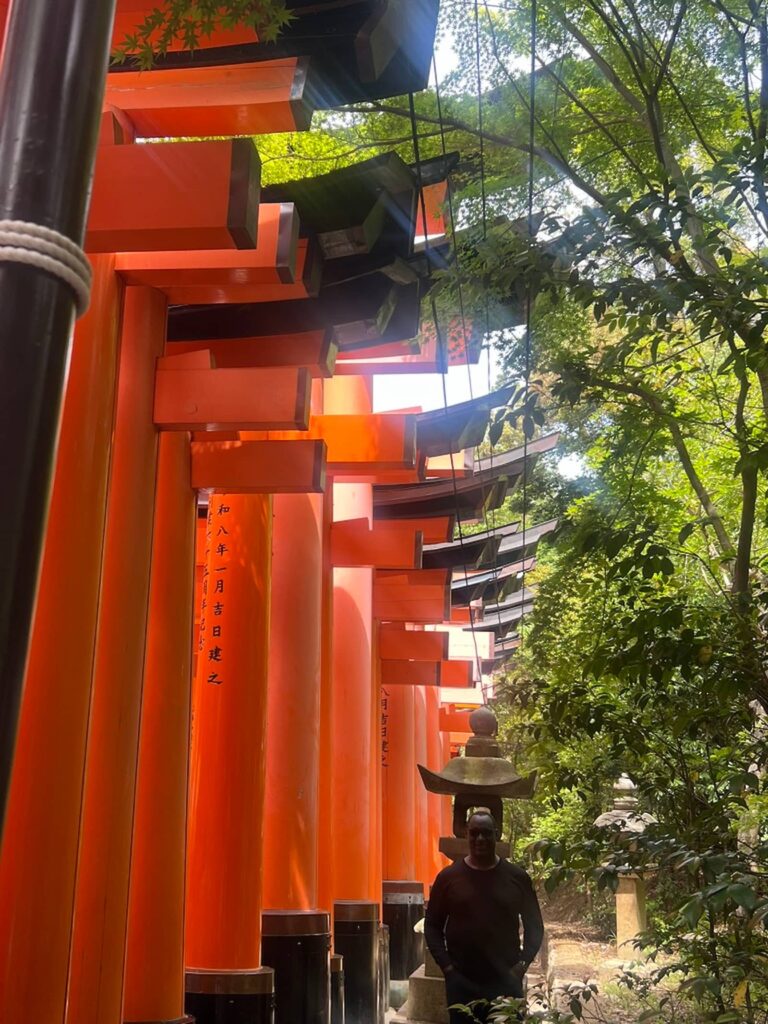
Our first morning in Kyoto began on the southeast side of the city, at Fushimi Inari Taisha. This is the shrine most people picture when they think of Kyoto — the one with hundreds of vibrant orange torii gates winding up the mountainside, each one donated by a business or individual hoping for prosperity. Walking beneath them, gate after gate after gate, there’s a rhythm that settles into your steps. It’s not a fast walk. It’s not meant to be. It’s a peaceful, almost meditative start to a city that would ask us to move at its pace, not ours — and it set exactly the right tone for the days ahead.
Shabu-Shabu and Streets Built for Wandering
Afterward, we sat down to a traditional shabu-shabu lunch at a local restaurant, watching thin slices of beef curl into a simmering broth, one small ritual at a time. Then we did what Kyoto does best to travelers: we let ourselves get lost. We wandered through historic streets lined with traditional wooden houses, tucked-away shops, and tea houses that have clearly been serving the same neighborhood for generations. Nothing about that afternoon was scheduled, and it was one of the best parts of the day.
An Indigo-Dyeing Workshop, and a Craft We Carried Home
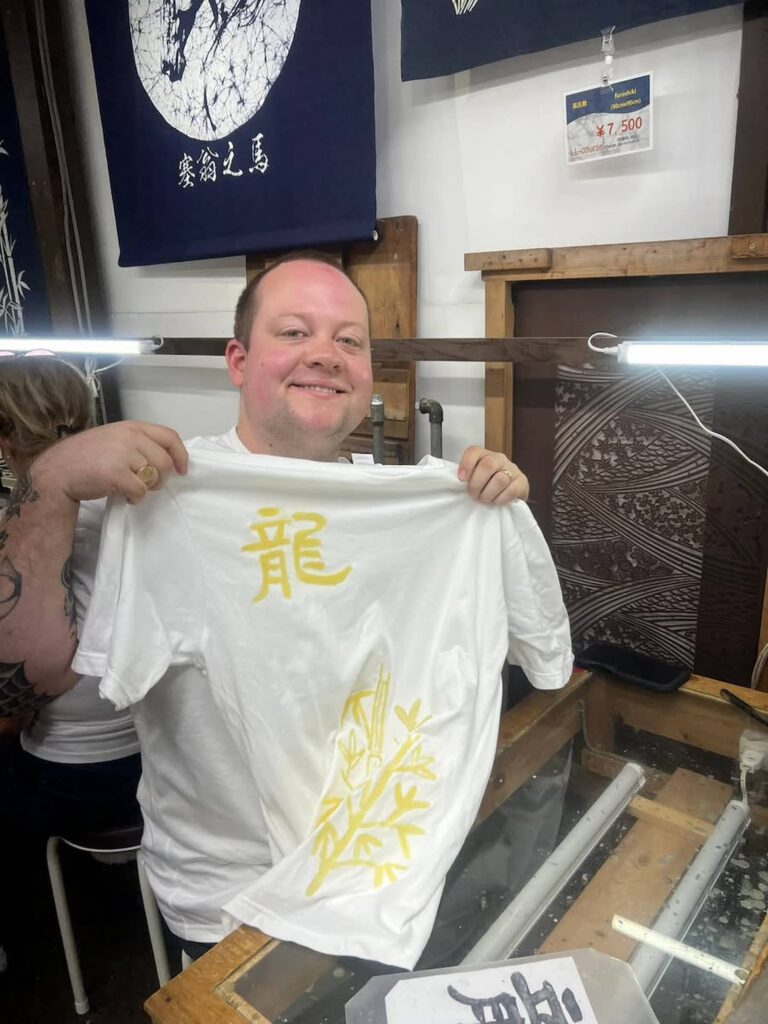
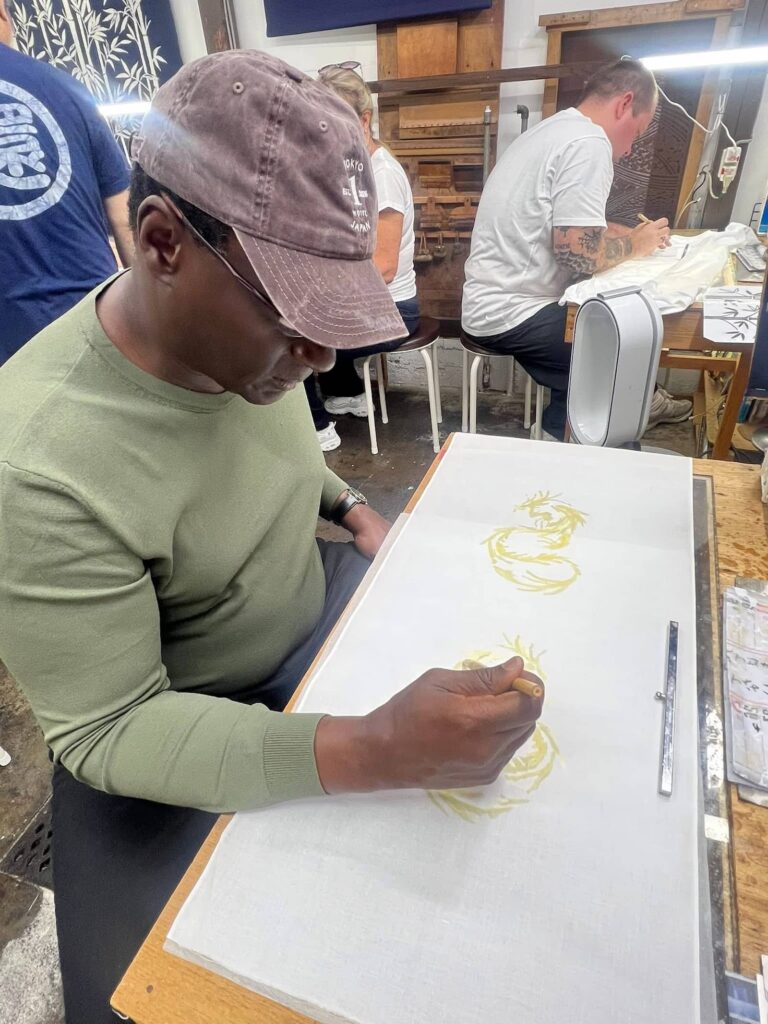
The next morning, we began with an indigo-dyeing workshop — and we were genuinely excited, because this was one piece of Japan we’d be bringing home with us in the fabric itself.
Indigo dyeing, known in Japan as aizome, is one of the country’s oldest textile traditions, with roots that stretch back over a thousand years to the Heian period. The process is almost entirely natural: leaves from the Japanese indigo plant are fermented — using nothing more than wheat bran, rice wine, wood ash, and lime — into a living dye called sukumo. Cloth dipped into the vat emerges a strange yellow-green, and it’s only when it hits the air and oxidizes that the color blooms into that unmistakable deep blue known around the world as “Japan Blue.” For centuries, indigo-dyed cloth wasn’t just decorative — it was practical, prized for being naturally insect-repellent and durable enough for samurai and farmers alike to wear it daily.
Standing over the vat ourselves, dipping fabric and watching it shift color in real time, it was hard not to feel the weight of that history in something so simple. We left with a piece we’d made with our own hands — not a souvenir bought off a shelf, but something we were part of.
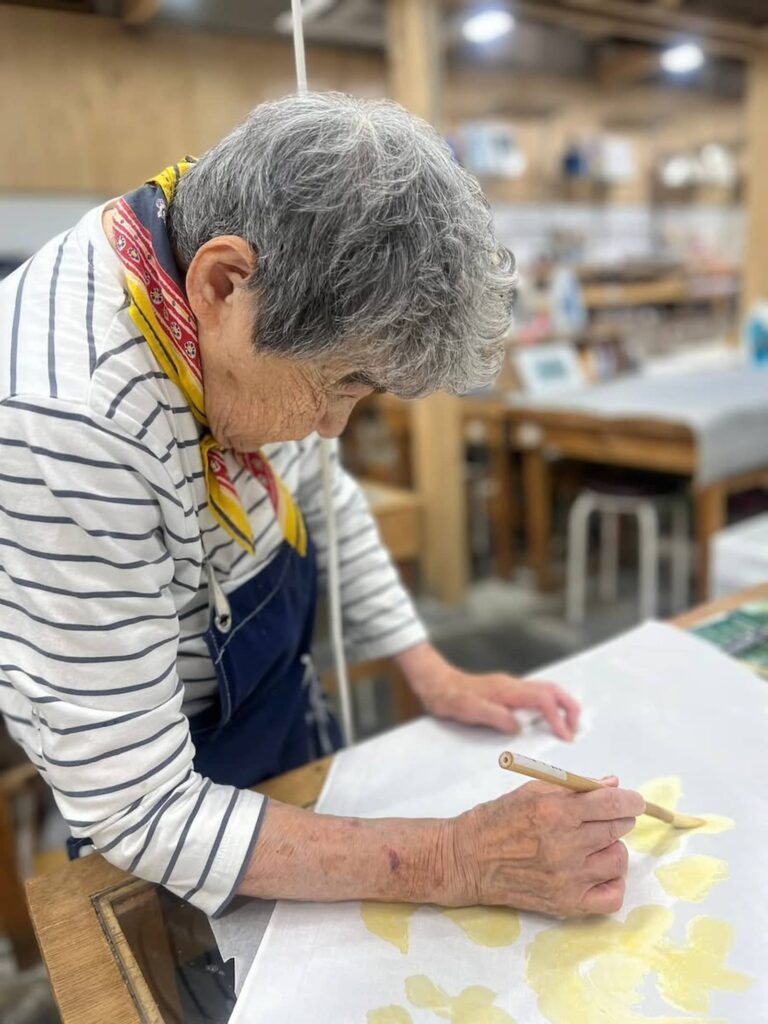
The workshop itself is a family-owned business, passed down through generations the way so many of Japan’s crafts are — not as a trade, but as an inheritance. And it was there that we met the grandmother of the family, quietly working alongside the younger hands being taught to us as visitors.
There’s a concept in Japanese culture that had stayed with me since Tokyo: the idea that every person holds three faces. One they show to the world. One they reveal only to family and close friends. And one — the most private, the most true — kept entirely for themselves.
She moved from workstation to workstation, observing. No words — none were needed. She would simply lean in, gently take the tool from your hands, and add her own touch before returning it. She communicated entirely with her eyes, and with respect. Watching her, it was easy to believe you were seeing all three faces at once — the patient teacher, the matriarch of a family craft, and something more private underneath both. It’s a version of ikigai, a reason for being, worn so naturally it barely needs a name.
There’s something about learning a craft from someone who has spent a lifetime inside it — who isn’t performing tradition for visitors, but simply living it — that reframes the whole experience. It wasn’t a workshop. It was an invitation into a family’s quiet purpose.
Arashiyama: Zen Gardens and a Grove of Bamboo
From there, our itinerary carried us west to Arashiyama, where we sat down to a traditional Buddhist lunch at Tenryu-ji, a temple known for its serene Zen gardens. There’s a stillness to that setting that’s hard to describe — the kind of quiet that asks you to lower your voice without anyone telling you to. No Kyoto travel guide is complete without an afternoon in Arashiyama, and once we stepped into the bamboo grove, it was easy to see why.
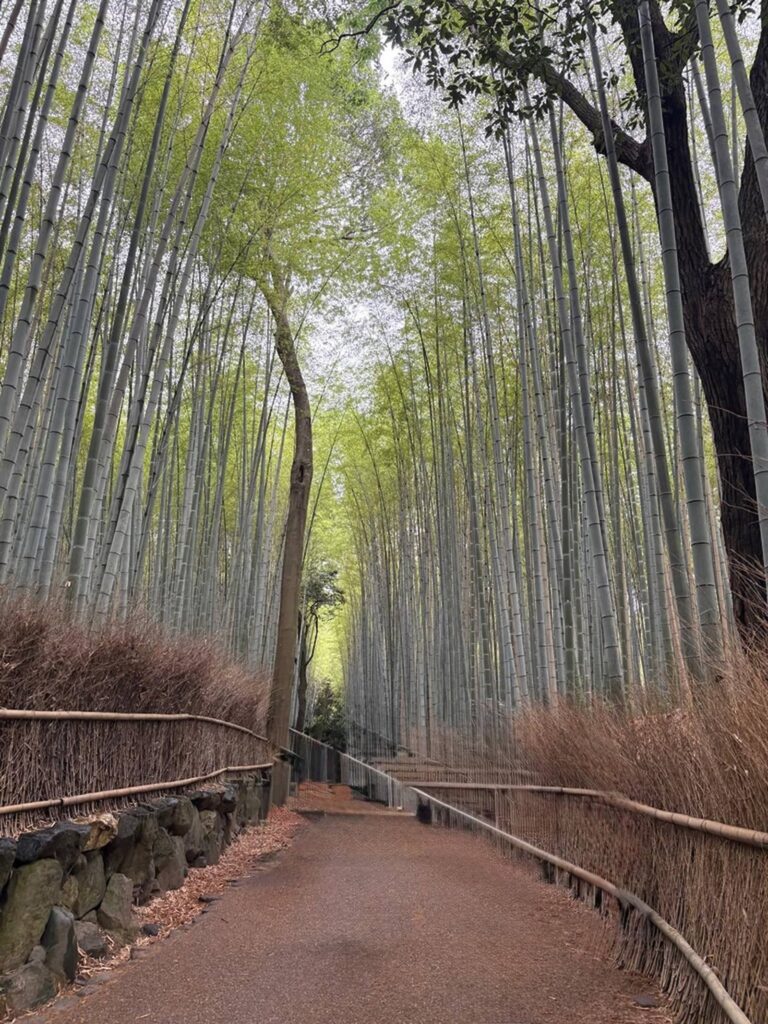
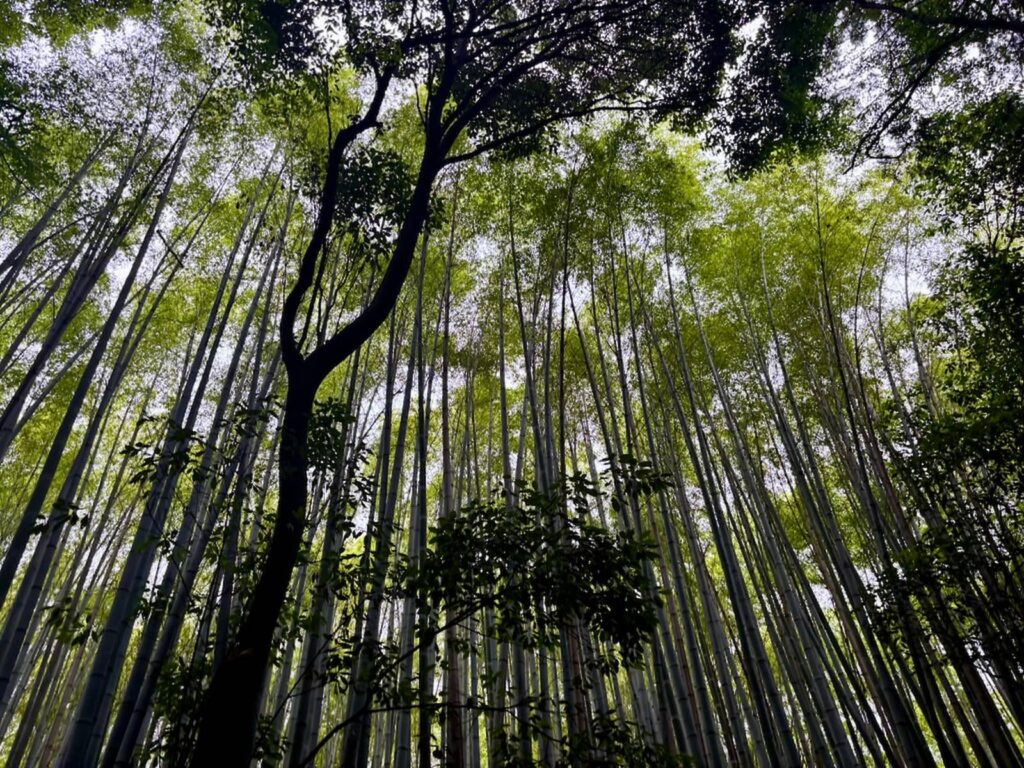
Following lunch, we strolled through the nearby Arashiyama Bamboo Grove, where towering stalks rise so high they close off the sky, and the wind moving through them creates a sound unlike anywhere else. It’s one of those places that photographs well but feels even better — uniquely tranquil, almost meditative, and a perfect quiet note to end our time in Kyoto on.
What Japan Taught Us
I’ve traveled to a lot of places — busy cities, remote villages, coastlines, mountain towns. But Japan did something different. It slowed me down and made me pay attention.
Moving through Tokyo, Tsubame, and Kyoto over several weeks, what stayed with me most wasn’t a single landmark or meal. It was the quiet, pervasive respect woven into every interaction, every street corner, every craft tradition. In Japan, the community always comes before the self — and once you feel it, you can’t unfeel it.
That idea of three faces followed us the whole way — sensed first while wiring a small bonsai into form at Shunkaen Bonsai Museum in Tokyo, felt again in the ring of a hammer shaping copper in Tsubame, and finally, unmistakably, in the quiet hands of the grandmother who moved between us during indigo dyeing here in Kyoto. Each craft asked for patience. Each maker gave us something rare: a glimpse of the private face most people never show a stranger.
We left Japan with more than dye-stained hands and a hand-hammered cup. We left with a slower pace, a sharper eye, and a deep appreciation for things made with intention — carried home the same way we carry the pieces themselves.



One Last Evening
On our final evening together, surrounded by newly made friends, we raised a glass to Japan — to its people, its culture, and the quiet, constant respect we witnessed everywhere we went, in ways big and small, for the entirety of this journey. It’s rare for a country to leave that specific kind of impression, the sense that you’ve been a guest in something much larger and more considered than a vacation.
A Small Note on Timing
One honest note for future travelers: it was hotter in May than we expected — noticeably so. If you’re sensitive to heat and humidity, it’s worth planning around. If you’re putting together your own Kyoto travel guide, plan for the heat — May ran hotter than we expected. My own second trip back to this beautiful country will likely be timed for cooler weather. Okinawa is already on my radar for that next chapter — a blue zone I’ve been wanting to explore — along with some of Japan’s more remote southern islands.
If Kyoto stirred something in you — a love of quiet ritual, of craft made by hand, of things worth carrying home — you’ll find the pieces I’ve collected from travels like this in my ShopMy storefront. Everything there is something I’ve personally used and loved.
👉 Shop My Favorites
Missed the beginning? Start with Tokyo and continue through Tsubame and Kanazawa before landing here in Kyoto.
About Freedom Always
Freedom Always Blog celebrates slow travel, artisan culture, and the hidden gems that make a journey unforgettable. If this post resonated with you, share it with someone who needs a reason to book that flight.
About the Author
Marie Leiter is the voice behind Freedom Always Blog — a slow traveler with a passion for hidden gems, authentic experiences, and life well-lived between two coasts.
2 thoughts on “Kyoto Travel Guide: Fushimi Inari, Bamboo Grove & More”
Well after reading all your chapters of travel experiences in Japan, you may have lit a fire underneath me to visit this peaceful, traditional, respectful country that I didn’t have on my bucket list! I almost felt like I was there.
Japan moves you, in ways you do not expect. I’m glad you’ve added Japan to your list!